Articles of Confederation
Passed by US Continental Congress Nov. 15, 1777
Enacted by the US Continental Congress March 1, 1781
Implemented by the United States in Congress Assembled March 2, 1781
Implemented by the United States in Congress Assembled March 2, 1781

Articles of Confederation Congress
United States in Congress Assembled (USCA) Sessions
USCA
|
Session Dates
|
USCA Convene Date
|
President(s)
|
First
|
03-01-1781 to 11-04-1781*
|
03-02-1781
| |
Second
|
11-05-1781 to 11-03-1782
|
11-05-1781
| |
Third
|
11-04-1782 to 11-02-1783
|
11-04-1782
| |
Fourth
|
11-03-1783 to 10-31-1784
|
11-03-1783
| |
Fifth
|
11-01-1784 to 11-06-1785
|
11-29-1784
| |
Sixth
|
11-07-1785 to 11-05-1786
|
11-23-1785
| |
Seventh
|
11-06-1786 to 11-04-1787
|
02-02-1787
| |
Eighth
|
11-05-1787 to 11-02-1788
|
01-21-1788
| |
Ninth
|
11-03-1788 to 03-03-1789**
|
None
|
None
|
* The Articles of Confederation was ratified by the mandated 13th State on February 2, 1781, and the dated adopted by the Continental Congress to commence the new United States in Congress Assembled government was March 1, 1781. The USCA convened under the Articles of Confederation Constitution on March 2, 1781.
** On September 14, 1788, the Eighth United States in Congress Assembled resolved that March 4th, 1789, would be commencement date of the Constitution of 1787's federal government thus dissolving the USCA on March 3rd, 1789.
With the passage of Lee’s Resolution and the Declaration of Independence, the U.S. Continental Congress was now faced with the challenge of transforming the voluminous United Colonies’ legislation into a U.S. Constitution capable of uniting and governing the 13 independent states. Even before the acceptance of those two momentous documents, the matter of drafting a constitution gained the serious attention of Congress on June 12th, 1776, when it resolved to appoint a committee of thirteen to prepare a draft constitution for the new republic:
Students and Teachers of US History this is a video of Stanley and Christopher Klos presenting America's Four United Republics Curriculum at the University of Pennsylvania's Wharton School. The December 2015 video was an impromptu capture by a member of the audience of Penn students, professors and guests that numbered about 200.
Resolved,
that the committee to prepare and digest the form of a confederation to be entered into between these colonies,
consist of a member from each colony:
·
for New Hampshire ... Mr. [Josiah] Bartlett
·
Massachusetts ... Mr. S[amuel] Adams
·
Rhode Island ... Mr. [Stephen] Hopkins
·
Connecticut ... Mr. [Roger] Sherman
·
New York ... Mr. R[obert R.] Livingston
·
New Jersey …
·
Pennsylvania ... Mr. [John] Dickinson
·
Delaware ... Mr. [Thomas] McKean
·
Maryland ... Mr. [Thomas] Stone
·
Virginia ... Mr. [Thomas] Nelson
·
North Carolina ... Mr. [Joseph] Hewes
·
S. Carolina ... Mr. [Edward]
Rutledge
·
Georgia ... Mr. [Button] Gwinnett [1]
On July 12th,
1776, the committee presented the first draft Articles of Confederation of the United States of America. The Continental Congress resolved:
That eighty copies, and no more, of the
confederation, as brought in by the committee, be
immediately printed, and deposited with the secretary, who shall deliver one
copy to each member: That a committee be appointed to superintend the press,
who shall take care that the foregoing resolution [Articles of Confederation].
That the printer be under oath to
deliver all the copies, which he shall print, together with the copy sheet, to
the secretary, and not to disclose either directly or indirectly, the contents
of the said confederation: That no member furnish any person with
his copy, or take any steps by which the said confederation may be re-printed, and that the secretary be
under the like injunction.[2]
The work on the new constitution would not be completed due to the
British advance, forcing a Continental Congress move first to Baltimore and
then, with the occupation of Philadelphia a flight to York-Town, Pennsylvania
in September 1777. The small hamlet located on the west side of the
Susquehanna River offered a protective natural barrier to British invasion.
York had an underutilized courthouse readily available to be used to reconvene
Congress in safety. Unlike Lancaster, where Congress had convened for a day,
York offered numerous accommodations to house the delegates comfortably. On
September 30th, the Continental Congress moved into this
35-year-old town of about 300 dwellings and 2,000 residents. John Adams, once settled in York-Town, wrote Abigail:
It is now a long Time, since I had an
Opportunity of writing to you, and I fear you have suffered unnecessary Anxiety
on my Account. -- In the Morning of the 19th. Inst., the Congress were
allarmed, in their Beds, by a Letter from Mr. Hamilton one of General
Washington’s Family, that the Enemy were in Possession of the Ford over the
Schuylkill, and the Boats, so that they had it in their Power to be in
Philadelphia, before Morning. The Papers of Congress,
belonging to the Secretary's Office, the War Office, the Treasury Office,
&c. were before sent to Bristol. The President, and all the other Gentlemen
were gone that Road, so I followed, with my Friend Mr. Merchant [Marchant] of
Rhode Island, to Trenton in the jersies. We stayed
at Trenton, until the 21. when We set off, to Easton upon the Forks of Delaware. From Easton We went to Bethlehem, from
thence to Reading, from thence to Lancaster, and from thence to this Town,
which is about a dozen Miles over the Susquehanna River. -- Here Congress is to
sit.
In order to convey the Papers, with
safeties, which are of more Importance than all the Members, We were induced to
take this Circuit, which is near 180 Miles, whereas this Town by the directest
Road is not more than 88 miles from Philadelphia. This Tour has given me an Opportunity
of seeing many Parts of this Country, which I never saw before.[3]
Philadelphia was lost, Fort Ticonderoga, also captured, and now the British, under the
command of General John Burgoyne,[4]
were marching down the Hudson Valley to cut off New England from the Middle
Atlantic States. These were perilous
days but the Continental Congress pressed on with their work conducting what
increasingly appeared to be a failing war effort. The work in York was prodigious as the delegates were in the
final stages of formulating the first U.S. Constitution, the Articles of
Confederation. The letters of the delegates report that
Congress typically met from 10 am to 1 pm and recessed until 4 pm. The “after recess sessions” often lasted
well into the evening. Committee duties, which were numerous, filled any
remaining delegate free time. John Hancock wrote to his wife Dorothy during this period:
I
sat in the Chair yesterday & Conducted the Business Eight hours, which is
too much, and after that had the Business of my office to attend to as usual …
I cannot Stand it much longer in this way" [5]
John Adams wrote to Abigail Adams of his tenure in York that “War has no Charms for me … If I live
much longer in Banishment, I shall scarcely know my own Children. Tell my
little ones, that if they will be very good, Pappa will come home.” [6]
Charles Carroll of Carrollton, a Maryland Delegate, wrote of his own York experience that
The Congress still continues the same
noisy, empty & talkative assembly it always was since I have known it. No
progress has been made in the Confederation tho' all seem desirous of forming
one. A good confederation I
am convinced would give us great strength & new vigor. This State is in a
great degree disaffected, & the well affected are inactive & supine.
This supiness & inactivity I attribute to the government & to the men
who govern; they want wisdom, influence, & the confidence of a very great
portion of the People, particularly of those whose abilities & activity
might in short time set things to rights.[7]
The Delegates grew
painfully aware that French monetary aid would not be forthcoming to their
cause without a constitution forming a nation out of 13 independent
States. The atmosphere of dread could
only be improved with the crafting of such a document which, despite what
Carroll reported to his father. Delegate
James Lovell wrote General Horatio Gates in Saratoga on October 5, 1777,
I believe we shall be able to get
speedily thro' the Articles of Confederation, and shall sit faithfully about the
Means of keeping our Currency in some sort of Credit.[8]
Henry Laurens, as a freshman
delegate, impressed the members of
Congress with his "nonpartisan"
deliberations on the Articles of Confederation. Laurens
remained steadfast against the nationalists' proposal to allow control of the
proposed new federal government by the wealthy. He was also against Virginia's proposal to have one
delegate in Congress for every 30,000 inhabitants, permitting each
representative one vote and thereby allowing the large States to control the
new federal government.
Was Delaware, Virginia, or New Hampshire the first US State?
On the Article that
prohibited the federal government from making any foreign treaty by preventing
the individual States "from imposing such imposts and duties on
foreigners as their own people are subject to", Laurens was the only
southern member to vote against the measure. Only three other states, Rhode
Island, New Hampshire, and Connecticut, voted with Laurens
so the restrictive amendment became a part of the first constitution. This shackled the confederation government’s efforts to properly control and
conduct foreign affairs for the United States of America.
In an unusual
position, Laurens voted for the new governing body called United States, in
Congress Assembled (USCA) to have the
authority to decide disputes between the States. Perplexingly, Laurens would later vote no on the establishment of an autonomous and separate governmental branch
necessary for such judicial matters to be employed. This failure to
separate the judicial duties of government from the legislative federal body
plagued the United States until the enactment of the current U.S. Constitution on March 4, 1789.
Significantly,
Laurens, in a final
constitutional act, voted against Virginia's last attempt to
gain more power in the federal government based on population. Specifically,
Virginia's amendment proposed that the nine votes necessary to determine matters
of importance in the USCA must be from the states containing a majority
of the white population in the new "Perpetual Union.” The measure failed largely because of
Laurens’ efforts, as well as the objections of the other smaller states..
The South Carolinian’s vote did not follow the “southern block”--clearly indicating Laurens was free from
sectional bias. He stood out time and time again, putting forth and supporting
articles and ideas that attempted to forge 13 individual States into one
unified nation. Laurens envisioned and worked diligently to form a
constitution that empowered a new central government to act for the benefit of
all states equally. This philosophy, along with his wealth, unknowingly made
him a leading candidate for the Presidency to replace the ailing John Hancock in October of 1777.
On October 20, 1777, the Continental Congress learned of
General Burgoyne’s defeat at Saratoga;[9] the British plan to sever the States
by controlling the Hudson River Valley had resulted in the capture of the
British General and his 6,000 troops. This was the news Congress and their
Foreign French Commissioner, Benjamin Franklin, desperately needed to convince
France to form an alliance with the United States. The
Franco-American Alliance, however, would require a constitutionally formed
United States of America to enact such a treaty. Work, therefore, on the
Articles of Confederation accelerated, progressing steadily under what
would be the last few days of John Hancock’s Presidency. Key amendments and
changes to the Articles were agreed on in the sessions of October 27th,
28th, and even the 29th when
John Hancock tendered his official resignation as President. So intent was
Congress on completing the Constitution that they re-convened immediately after
Hancock’s departure resolving unanimously by vote, "Resolved, That the secretary officiate as president until a new
choice is made." They went back to work with Charles Thomson officiating
over the Articles of Confederation debates and resolutions. The Journals report:
Congress resumed the consideration of
the 14 article of confederation, whereon it was moved to strike out the
words "general officers" in the 24 line, and insert "all
officers:" and to add after "United States," "excepting
regimental officers." And on the question put, the same was agreed to. It
was then moved to strike out the next paragraph, and in the following
paragraph, after the word "forces" to insert these words, "and
commissioning all officers whatever." And on the question put, the same
was agreed to.
The president having taken leave of
Congress. Four o'Clock, pm. Met at 4’
O’clock, Resolved, That the secretary officiate as president until a new choice
is made. On motion, Ordered, That the secretary wait upon the president and
request him to furnish the house with a copy of the speech with which he took
leave of Congress. [10]
Congress would meet
only once more, on October 30th, 1777, to debate and revise the
Articles of Confederation with Secretary Charles Thomson presiding. The Articles would not be finalized, however,
until a new President of the Continental Congress was elected to the presiding office. On October 31st, 1777, Secretary
Thomson turned to other business and presented congress with General Horatio
Gates’ official notification of the Saratoga Convention. The Continental Congress Journals report:
A letter, of the 18 October, from General Gates, with the
copy of the convention at Saratoga, whereby General Burgoyne surrenders himself and his whole army; and another,
of the 20th, enclosing the copy of a letter from him to Major General John
Vaughan, were read.[11]
The spirit of the
delegates soared as the thorough defeat of General Burgoyne was far more than anyone anticipated. The following day, to Henry Laurens’ astonishment, the Chair nominated him to be
the President of the Continental Congress. The vote was taken and with unanimous
approval, he was elected the fourth President of a very festive Continental
Congress.
Henry Laurens’ first official act as the President was to
preside and vote for a Day of Thanksgiving and "to adore the
superintending providence of Almighty God". In his first letter to the
13 States, President Laurens declared:
Dear Sir, The Arms of the United States of America having been blessed in the present Campaign with remarkable Success, Congress have Resolved to recommend that one day, Thursday the 18th December next be Set apart to be observed by all Inhabitants throughout these States for a General thanksgiving to Almighty God. And I have it in command to transmit to you the inclosed extract from the minutes of Congress for that purpose. [12]

November
1, 1777 Thanksgiving Proclamation - Library of Congress,
Rare Book and Special Collections Division. [13]
Henry Laurens did not reconvene the Continental Congress until November 4th, when they
officially thanked General Horatio Gates[14]
and his army for their defense against Burgoyne's invasion as well
as various other officers and units for their defense of the Delaware. After another recess, Congress reconvened on
November 7th to reorganize the Board of War and agreed to resume
debate to finalize the Articles of Confederation. The constitutional
deliberations resumed on the 10th, with the Delegates working until
the morning of November 15th, 1777, concluding the session with the
passage of the Articles of Confederation.
Under
this new constitution, the Continental Congress would cease to exist and a new body, the
United States, in Congress Assembled (USCA), would become the
federal government of a “Perpetual Union between the states of New Hampshire, Massachusetts-bay, Rhode Island and Providence Plantations, Connecticut, New York, New Jersey, Pennsylvania, Delaware, Maryland, Virginia, North Carolina, South Carolina and Georgia.” [15]
The Articles constituted a feeble
constitution, a confederation of sovereign States that formed a Not Quite
Perpetual Union based on mutual respect and a central government with no taxing
power. The federal government also had
no power to regulate trade between the States. The national government would have
to ask the States for money to wage war, establish federal departments, hire
employees, maintain a judicial system and carry out the host of laws Congress
passed to govern the new United States of America. The States were expected, in a most gentlemanly
fashion, to comply with all constitutional requests, bequeathing the federal
government with money and land to fund its national endeavors.
The
legislative, executive and judicial systems were all entrusted to one body: the
“United States in Congress Assembled.”
Each State had only one vote despite its population or its size, “all equal in the eyes of God.” Presidents served only one year and Congress
rotated candidacy between North and South.
The Presidents and Commander-in-Chief accepted only expenses for their
services. It was a furtive commune where all members pledged secrecy and
service for God and the people of their respective States that were freely
united and desperately seeking peace.
In
summary, the first constitution’s Articles:
I. Establish the name of the nation as "The United States of America;"
II. State that "Each state retains its sovereignty, freedom, and independence, and every power, jurisdiction, and right, which is not by this Confederation expressly delegated” to the new federal government called the “United States, in Congress Assembled” (USCA);[16]
III. Establish the Sovereign States as one Sovereign nation ". . . for their common defense, the security of their liberties, and their mutual and general welfare, binding themselves to assist each other, against all force offered to, or attacks made upon them . . . ;"
IV. Establish the freedom of citizens to pass freely between states, excluding "paupers, vagabonds, and fugitives from justice." All the people were also entitled to the rights established by the State into which they traveled. If a crime were committed in one state and the perpetrator to flee to another state, the citizen would be extradited to and tried in the State in which the crime had been committed;
V. Equality was established in the United States in Congress Assembled with only one vote to each State, regardless of size, but delegations might have from two to seven members. Members of the USCA were elected or appointed by state legislatures and could serve no more than three out of any six years; [17]
VI. Only the USCA was permitted to conduct foreign relations and to declare war. No states were permitted to have navies or standing armies, or engage in war, without permission of USCA. State militias were encouraged;
VII. When an Army was raised for common defense, colonels and military ranks below colonel were to be named by the state legislatures;
VIII. Expenditures by the USCA were paid by funds raised by State legislatures and apportioned based on the real property values of each;
IX. The ninth- article defined the powers of the central government:
a. USCA sends and receives ambassadors
b. USCA enters into treaties and alliances, provided that no treaty of commerce shall be made whereby the legislative power of the respective States shall be restrained from imposing such imposts and duties on foreigners, as their own people are subjected to, or from prohibiting the exportation or importation of any species of goods or commodities whatsoever;
c. USCA establishes the rules for deciding, in all cases, what captures on land or water shall be legal, and in what manner prizes taken by land or naval forces in the service of the United States shall be divided or appropriated;
d. USCA grants letters of marque (diplomacy) and reprisal in times of peace;
e. USCA appoints courts for the trial of piracies and felonies committed on the high seas and establishes courts for receiving and determining finally appeals in all cases of captures, provided that no member of Congress shall be appointed a judge of any of the said courts;
f. USCA fixes the standards of weights and measures throughout the United States;
g. USCA regulates the trade and management of all affairs with Indians, not members of any of the States, provided that the legislative right of any State within its own limits be not infringed or violated;
h. USCA establishes or regulates post offices from one State to another, throughout all the United States. They also exact postage on the papers passing through the post office to defray the expenses of the bureau;
i. USCA appoints all officers of the land forces, in the service of the United States, excepting regimental officers;
j. USCA appoints all the officers of the naval forces, and commissions all officers whatever in the service of the United States;
k. USCA makes rules for the government and regulation of the said land and naval forces, and direction of their operations;
l. USCA serves as a final court for disputes between states;
m. USCA defines a Committee of the States to be a government when Congress is not in session;
n. USCA elects one of their members to preside, provided that no person be allowed to serve in the office of president more than one year in any term of three years
X. The Committee of the States, or any nine of them, shall be authorized to execute, in the recess of USCA, such of the powers of the USCA. The President of the USCA is to chair the Committee of the States;
XI. Nine states required to approve the admission of a new state into the confederacy; pre-approves Canada, should it apply for membership;
XII. Reaffirms that the Confederation accepts war debt incurred by the Continental Congress before the Articles;
XIII. Declares that the Articles of Confederation are perpetual, and can only be altered by approval of Congress with ratification by all the state legislatures.[18]
The Continental
Congress, after 16 months of
debate and deliberations, forged the United States Constitution of 1777,
creating one nation empowered to govern but with one caveat: All 13 States were
required to ratify the constitution before it would officially take effect.


US Constitution Day at Loyola University New Orleans September 17, 2014
The 1777 Maryland Plan, even before the Articles
of Confederation were
passed by the U.S. Continental Congress, proposed that the USCA would have the
sole right and power over the frontier lands “North and West of the Ohio
River,” later known as the Northwest
Territory. This measure, however, was heartily opposed by
Virginia, New York, Connecticut, and Massachusetts who all had vast interior
claims to the Northwest Territory. The Southern states of Georgia,
South and North Carolina also had claims that stretched all the way to the
Mississippi River. Maryland was alone but knowing that the constitution
required state assembly ratification, its delegates approved the Articles of
Confederation on November 15, 1777. The question of Northwest Territorial land
claims was left to be considered by the individual state governments who were
charged with the review and ratification of the Articles of
Confederation.
On May 21, 1779, after 12 States had ratified
the Articles, the Maryland State Assembly formally communicated to the U.S.
Continental Congress its conditions for ratification. The assembly gave
notice that it would only ratify the Articles if they received definite assurances
that the Northwest
Territory would be
released by the states to the USCA:
We are convinced policy and justice require
that a country unsettled at the commencement of this war, claimed by the
British Crown, and ceded to it by the treaty of Paris, if wrested from the
common enemy by the blood and the treasure of the 13 States, should be
considered as a common property, subject to be parceled out by Congress into
free, convenient, and independent governments, in such manner and at such times
as the wisdom of that assembly shall hereafter direct.[19]
It was now the charge of Continental Congress
Delegates John Hanson and Daniel Carroll to persistently press this demand of
their State.
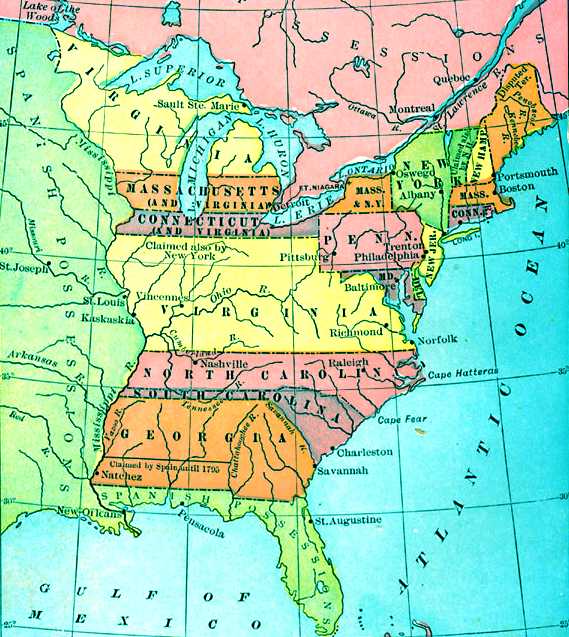
U.S. State 1776-1781 claims on land east of the Mississippi River.
On September 6, 1780 the U.S. Continental
Congress acted on the Maryland Plan resolving that the western territory be
released and Maryland ratify the Articles of Confederation.
The Journals report:
Congress took into consideration the report of
the committee to whom were referred the instructions of the general assembly of
Maryland to their delegates in Congress, respecting the articles of
confederation, and the declaration therein referred to, the act of the
legislature of New York on the same subject, and the remonstrance of the
general assembly of Virginia; which report was agreed to, and is in the words
following:
"That having duly considered the several
matters to them submitted, they conceive it unnecessary to examine into the
merits or the policy of the instructions or declaration of the general assembly
of Maryland, or of the remonstrance of the general assembly of Virginia, as
they involve questions, a discussion of which was declined on mature
consideration, when the articles of confederation were debated; nor, in the
opinion of the committee, can such questions be now revived with any prospect
of conciliation; that it appears more advisable to press upon those states
which can remove the embarrassment respecting the western country, a liberal
surrender of a portion of their territorial claims, since they cannot be
preserved entire without endangering the stability of the general confederacy;
to remind them how indispensably necessary it is to establish the federal union
on a fixed and permanent basis, and on principles acceptable to all its
respective members; how essential to public credit and confidence, to the
support of our army, to the vigor of our councils and success of our measures,
to our tranquility at home, and our reputation abroad, to our present safety
and our future prosperity, to our very existence as a free, sovereign and
independent people; that they are fully persuaded the wisdom and magnanimity of
the patriotic legislators of these states will on an occasion of such vast
magnitude, prompt them to prefer the general security to local attachment, and
the permanency of the confederacy to an unwieldy extent of their respective
limits, of the respective legislatures will lead them to a full and impartial
consideration of a subject so interesting to the United States, and so
necessary to the happy establishment of the federal union; that they are
confirmed in these expectations by a review of the before mentioned act of the
legislature of New York, submitted to their consideration; that this act is
expressly calculated to accelerate the federal alliance, by removing, as far as
it depends on that State, the impediment arising from the western country, and
for that purpose to yield up a portion of territorial claim for the general
benefit; an example which in the opinion of your committee deserves applause,
and will produce imitation," Whereupon,
Resolved, That copies of the several papers
referred to the committee be transmitted, with a copy of the report, to the
legislatures of Virginia, North Carolina and Georgia the several states, and
that it be earnestly recommended to those states, who have claims to the
western country, to pass such laws, and give their delegates in Congress such
powers as may effectually remove the only obstacle to a final ratification of
the articles of confederation; and that the legislature of Maryland be
earnestly requested to authorize their delegates in Congress to subscribe the
said articles; and that a copy of the aforementioned remonstrance from the
assembly of Virginia and act of the legislature of New York, together with a
copy of this report, be transmitted to the said legislature of Maryland.[20]
On October 10th Congress adopted Virginia proposal,
moved by Delegate James Madison,
to reimburse state expenses related to cession of western lands and to require
that ceded lands "be disposed of for the common benefit of the United
States.” The Journals
record:
Resolved, That the unappropriated lands that
may be ceded or relinquished to the United States, by any particular states,
pursuant to the recommendation of Congress of the 6 day of September last,
shall be granted and disposed of for the common benefit of all the United
States that shall be members of the federal union, and be settled and formed
into distinct republican states, which shall become members of the federal
union, and have the same rights of sovereignty, freedom and independence, as
the other states: that each state which shall be so formed shall contain a
suitable extent of territory, not less than one hundred nor more than one
hundred and fifty miles square, or as near thereto as circumstances will admit:
and that upon such cession being made by any State and approved and accepted by
Congress, the United States shall guaranty the remaining territory of the said
States respectively. That the necessary and reasonable expenses which any
particular state shall have incurred since the commencement of the present war,
in subduing any of the British posts, or in maintaining forts or garrisons
within and for the defense, or in acquiring any part of the territory that may
be ceded or relinquished to the United States, shall be reimbursed; That the
said lands shall be granted and settled at such times and under such
regulations as shall hereafter be agreed on by the United States in Congress
assembled, or any nine or more of them. That all purchases made of the Indians
of any of said lands by private persons, without the approbation of the
Legislature of the State to whom the right of preemption belonged, shall not be
deemed valid to make a title to such purchases. That no purchases and deeds
from any Indians or Indian nations, for lands within the Territory to be ceded
or relinquished, which have been made without the approbation of the
legislature Postponed of the state within whose limits it lay for the use of
any private person or persons whatsoever make a title to the purchasers shall
not have been rated by lawful authority, shall be deemed valid or ratified by
Congress.[21]
USCA President Samuel Huntington, a delegate from
Connecticut, led the way for other congressional delegations when he
successfully convinced his state legislature to relinquish their western lands
claims to the federal government. On November 28, 1780 John Hanson wrote Charles
Carroll of Carrollton:
The president of Congress has promised to send
by this post, a Copy of a late Law passed in Connecticut, respecting a Cession
of some part of the back Lands. We have had nothing from Virginia or any other
state on that Subject.[22]
Maryland, thanks to John Hanson, Daniel
Carroll, James Madison, Samuel Huntington and others brokering land cessions
from the states, finally passed an act to empower their delegates to subscribe
and ratify the Articles of Confederation on January 30th, 1781. On February 2,
1781 Governor Thomas Sim Lee signed the empowerment into law. On February
20th, Daniel Carroll, after presenting Maryland’s ratification of
the Articles to Congress, took a moment to write Charles
Carroll of Carrollton:
On the first day of my appearing in Congress, I delivered the Act empowering the Delegates of Maryland to Subscribe the Articles of Confederation &c.! It was read, & entered on the Journals.[23]
John Hanson, the second delegate
authorized to ratify the Articles
of Confederation for Maryland, arrived in Philadelphia two days
later. Although Article V of the constitution stated that “… the United States,
delegates shall be annually appointed in such manner as the legislatures of
each State shall direct, to meet in Congress on the first Monday in November,
in every year,” all the
Congressional delegates were now duly appointed after their respective states
had ratified the Articles of Confederation. Congress, who had waited on Maryland’s
approval since the 12th state’s ratification in February 1779, decided
to not to delay the formation of the “Perpetual
Union” confederation until November 5, 1781. On February 22, 1781, it was unanimously resolved
that:

The Articles of Confederation government was thus deemed to be in full force by the USCA, with Samuel Huntington, not John Hanson as claimed by the State of Maryland, as the President. As irrefutable proof that Samuel Huntington's USCA was obliged to comply with the Articles of Confederation, below is an image of two different entries from the Journals of Congress. The first entry is from the December 24th, 1778, Continental Congress vote tally taken while President Henry Laurens was presiding. The states of New Hampshire, Delaware, Rhode Island, and Georgia each had only one delegate present, and the States' votes of "ay" were registered as "ay" in the tally:
As a final "voting proof" that President Samuel Huntington presided as the first USCA President, here is a third entry from November 14th, 1781, of a United States in Congress Assembled vote tally taken while President John Hanson was presiding. The states of Connecticut and North Carolina each had only one delegate present, and the States' votes of "ay" were again registered as " * ", having no effect in the tally:
The delegates of Maryland having taken their
seats in Congress with powers to sign the Articles of Confederation: Ordered,
That Thursday next [March 1, 1781] be assigned
for compleating the Confederation; and that a committee of three be appointed,
to consider and report a mode for announcing the same to the public: the
members, [Mr. George] Walton, Mr. [James]
Madison, Mr. [John] Mathews.[1]
 |
| Journals of Congress showing Maryland's Delegates Articles of Confederation March 1, 1781 ratification Stan Klos Collection |
On that date, the Articles of Confederation were adopted and the Pennsylvania Gazette reported:
In pursuance of an Act of
the Legislature of Maryland, entitled, 'An Act to empower the Delegates of the
State in Congress to subscriber and ratify the Articles of Confederation,' the
Delegates of the said State, on Thursday last, at twelve o, signed and ratified
the Articles of Confederation; by which act the Confederation of the United
States of America was completed, each and every of the Thirteen States, from
New Hampshire to George, both included, having adopted and confirmed, and by
their Delegates in Congress ratified the same.
This happy even was
immediately announced to the public by the discharge of the artillery on land,
and the cannon of the shipping in the river Delaware. At two o’ clock his
Excellency the President of Congress received on this occasion the
congratulations of the Hon. the Minister Plenipotentiary of France, and of the
Legislative and Executive Bodies of this State, of the Civil and Military
Officers, sundry strangers of distinction in town, and of many of the principal
inhabitants.
The evening was closed
by an elegant exhibition of fireworks. The Ariel frigate, commanded by the
gallant John Paul Jones, fired a feu de joye, and was beautifully decorated
with a variety of streamers in the day, and ornamented with a brilliant
appearance of lights in the night.
Thus will the first of
March, 1781, be a day memorable in the annals of America, for the final
ratification of the Confederation and perpetual Union of the Thirteen States of
America --- A Union, begun by necessity, cemented by oppression and common
danger, and now finally consolidated into a perpetual confederacy of these new
and rising States: And thus the United States of America, having, amidst the
calamities of a destructive war, established a solid foundation of greatness, are
growing up into consequence among the nations, while their haughty enemy,
Britain, with all her boasted wealth and grandeur, instead of bringing them to
her feet and reducing them to unconditional submission, finds her hopes
blasted, her power crumbling to pieces, and the empire which, with overbearing
insolence and brutality she exercised on the ocean, divided among her insulted neighbors.

The
following day, March 2nd, 1781, the United States in Congress Assembled (USCA) convened
as the new government of the United States of America with Samuel Huntington as President. Secretary Charles Thomas began the new journal by placing “The United States in Congress Assembled" at the head of the first page. The United States of America, which was conceived on July 2, 1776, proclaimed on the 4th, and re-formulated on November 15, 1777, had finally been constitutional born with the Articles of Confederation’s ratification. The USCA Journal reports:
The ratification of the Articles of Confederation being yesterday completed by the accession of the State of Maryland: The United States met in Congress, when the following members appeared: His Excellency Samuel Huntington, delegate for Connecticut, President...[26]
 |
| USCA Journals 1781 printing for March 2nd showing name change and Samuel Huntington appearing as President - Stan Klos Collection |
With the U.S. Continental Congress dissolved and the first U.S. Constitution now in effect, the United States in Congress Assembled government was immediately challenged with the fact that the Articles of Confederation required that both New Hampshire and Rhode Island, states with only one delegate physically present in the USCA, be excluded from voting in the new assembly. This was particularly dicey because, the day before, the two delegates had voted, as members of the Continental Congress, on numerous Treasury and Board of War resolutions required to conduct the war against Great Britain. Delaware Delegate Thomas Rodney, in his diary’s entry dated March 2nd, 1781, explained the conundrum faced by the USCA on Delegate voting in the new Congress:
The States of New Hampshire and Rhode Island having each but one Member in Congress, they became unrepresented by the Confirmation of the Confederation-By which not more than Seven nor less than two Members is allowed to represent any State -Whereupon General Sullivan, Delegate from New Hampshire moved - That Congress would appoint a Committee of the States, and Adjourn till those States Could Send forward a Sufficient number of Delegates to represent them-Or that they would allow their Delegates now in Congress To give the Vote of the States until one More from each of those States was Sent to Congress to Make their representation Complete.
He alleged that it was but just for Congress to do one or the other of them-for that the act of Congress by completing the Confederation ought not to deprive those States of their representation without giving them due Notice, as their representation was complete before, & that they did not know When the Confederation Would be Completed. Therefore if the Confederation put it out of the power of Congress to Allow the States vote in Congress because there was but one member from each them, they ought in justice to those States to appoint a Committee of the States, in which they would have an Equal Voice. This Motion was Seconded by Genl. Vernon from Rhode Island and enforced by Arguments to the same purpose.But all their Arguments were ably confuted by Mr. Burke of N.C. and others, and the absurdity of the motion fully pointed out, So that the question passed off without a Division -But it was the general Opinion of Congress that those members might Continue to Sit in Congress, and Debate & Serve on Committees though they could not give the vote of their States.
It was unanimously agreed by the USCA that the Articles of Confederation was in full force and for a State to have a vote in the new Congress, unlike the U.S. Continental Congress, two or more delegates were required in accordance with Article V: "No State shall be represented in Congress by less than two, nor more than seven members."
The Articles of Confederation government was thus deemed to be in full force by the USCA, with Samuel Huntington, not John Hanson as claimed by the State of Maryland, as the President. As irrefutable proof that Samuel Huntington's USCA was obliged to comply with the Articles of Confederation, below is an image of two different entries from the Journals of Congress. The first entry is from the December 24th, 1778, Continental Congress vote tally taken while President Henry Laurens was presiding. The states of New Hampshire, Delaware, Rhode Island, and Georgia each had only one delegate present, and the States' votes of "ay" were registered as "ay" in the tally:
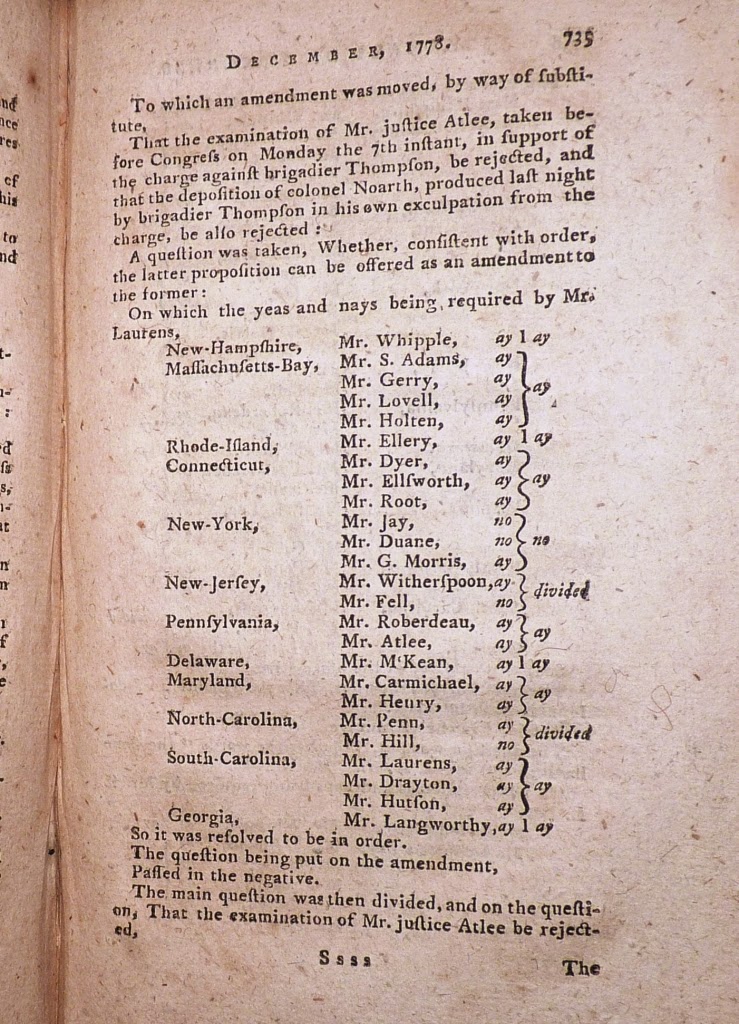 |
Thursday, December 24, 1778 Journals of Congress entry of the US Continental Congress vote on " the support of the charge against Brigadier Thompson, be rejected, and that the deposition of Colonel Noarth, produced last night by Brigadier Thompson in his own exculpation from the charge, be also rejected ... passed in the negative" Journals of Congress Containing the proceedings from January 1st, 1779 to Jan. 1st, 1780 PUBLISHED BY ORDER OF Congress, Philadelphia, by David Claypoole, VOLUME V. -- Image courtesy of the Historic.us Collection. |
The second entry is from the March 22nd, 1781, United States in Congress Assembled vote tally taken while President Samuel Huntington was presiding. The states of New Hampshire, Maryland, Rhode Island, and Georgia each had only one delegate present, and the States' votes of "ay" were registered as " * " having no effect in the tally:
 |
Thursday, MARCH 22, 1781 Journals of Congress entry of the USCA vote "Resolved, That there be one deputy director of the military hospitals,in the Southern district subject to the general control of the director... So it passed in the negative." The Journals of Congress and the United States in Congress Assembled, For the Year 1781, Published By Order of Congress, Volume VII New York: Printed by John Patterson. -- Image courtesy of the Historic.us Collection. |
 |
Wednesday, November 14, 1781 Journals of Congress entry of the USCA vote "That the first Tuesday of December next, be assigned for the consideration of the report of the committee, to whom were referred the cessions of New York, Virginia, Connecticut, and the petitions of the Indiana, Vandalia, Illionois, and Wabash companies. A motion was made by Mr. Smith, seconded by Mr. Varnum, to amend, by adding, "provided that eleven states shall be then represented." On the question to agree to the amendment, the yeas and nays being required by Mr. Varnum, ... So it passed in the negative." The Journals of Congress and the United States in Congress Assembled, For the Year 1781, Published By Order of Congress, Volume VII New York: Printed by John Patterson. -- Image courtesy of the Historic.us Collection. |
Important legislation was passed by the USCA in this first session but the "game changer" for the USCA Presiddent occurred after three months of committee work and a final debate. On May 4th, 1781, the United States in Congress Assembled (USCA) approved the thirty-five rules for conducting the nation’s business under the Articles of Confederation. [27] The new rules stripped the Presidential office of its political powers including the duty to choose when and what matter came before Congress:
 |
Rules for Conduction Business, May 4th, 1781, entry of The Journals of Congress and the United States in Congress Assembled, For the Year 1781, Published By Order of Congress, Volume VII New York: Printed by John Patterson. This entry reports the that new governing entity, The United States in Congress Assembled, now governs the United States of America -- Image courtesy of the Historic.us Collection. |
Rules for Conducting Business in the United States in Congress Assembled.
1. As soon as seven states are met the President may assume the chair, upon which the members shall take their seats.
2. The minutes of the preceding day shall then be read, and after that the public letters, petitions and memorials, if any have been received or presented.
3. Every letter, petition or memorial read, on which no order is moved, shall of course be considered as ordered to lie on the table, and may be taken up at any future time.
4. After the public dispatches, &c., the reports of committees which may have been delivered by them to the secretary during that morning or the preceding day shall, for the information of the house, be read in the order in which they were delivered, and, if it is judged proper, a day be assigned for considering them.
5. After the public letters, &c., are read, and orders given concerning them, the reports of the Board of Treasury and of the Board of War, if any, shall be taken into consideration; but none of those subjects for the determination of which the assent of nine states is requisite shall be agitated or debated, except when nine states or more are assembled. When a doubt is raised whether any motion or question is of the number of those for the determination of which in the affirmative the articles of confederation require the assent of nine states, the votes and assent of nine states shall always be necessary to solve that doubt, and to determine upon such motions or questions.
6. When a report, which has been read and lies for consideration, is called for it shall immediately be taken up. If two or more are called for, the titles of the several reports shall be read, and then the President shall put the question beginning with the first called for, but there shall be no debate, and the votes of a majority of the states present shall determine which is to be taken up.
7. An order of the day, when called for by a State shall always have the preference and shall not be postponed but by the votes of a majority of the United States in Congress assembled.
8. When a report is brought forward for consideration it shall first be read over and then debated by paragraphs and each paragraph shall be subject to amendments. If it relates only to one subject being in the nature of an ordinance it shall be subject to such additions as may be judged proper to render it complete and then it shall be read over as it stands amended and a question taken upon the whole: But if it comprehends different subjects, independent one of another, in the form of distinct acts or resolutions a question shall be taken on each and finally a question on the whole.
9. No motion shall be received unless it be made or Negatived, seconded by a state. When any ordinance is introduced by report or otherwise, it shall be read a first time for the information of the house without debate. The President shall then put the following question "Shall this ordinance be read a second time." If it passes in the affirmative then a time shall be appointed for that purpose when it shall be read and debated by paragraphs and when gone through, the question shall be "Shall this ordinance be read a third time"; if agreed to, and a time appointed, it shall be accordingly read by paragraphs, and if necessary debated, and when gone through the question shall be "Shall this ordinance pass", if the vote is in the affirmative, a fair copy shall then be made out by the Secretary, either on parchment or paper and signed by the President and attested by the Secretary in Congress and recorded in the Secretary's office.
10. When a motion is made and seconded it shall be repeated by the President or If he or any other member desire being in writing it shall be delivered to the President in writing and read aloud at the table before it, shall be debated.
11. Every motion shall be reduced to writing and read at the table before it is debated if the President or any member require it.
12. After a motion is repeated by the President or read at the table it shall then be in the possession of the house, but may at any time before decision, be withdrawn, with the consent of a majority of the states present.
13. No member shall speak more than twice in any one debate on the same day, with-out leave of the house, nor shall any member speak twice in a debate until every member, who chooses, shall have spoken once on the same.
14. Before an original motion shall be brought before the house, it shall be entered in a book to be kept for the purpose and to lie on the table for the inspection of the members, and the time shall be mentioned underneath when the motion is to be made, that the members may some prepared and nothing he brought on hastily or by surprise.
15. When a question is before the house and under debate, no motion shall be received unless for amending it, for the previous question, or to postpone the consideration of the main question or to commit it.
16. No new motion or proposition shall be admitted under color of amendment as a substitute for the question or proposition under debate until it is postponed or disagreed to.
17. When a motion is made to amend by striking out certain words, whether for the purpose of inserting other words or not, the first question shall be "Shall the words moved to be struck out stand?"
18. The previous question (which is always to be understood in this sense that the main question be not now put) shall only be admitted when in the judgment of two states at least, the subject moved is in its nature or from the circumstances of time or place improper to be debated or decided, and shall therefore preclude all amendments and farther debates on the subject, until it is decided.
19. A motion for commitment shall also have preference and preclude all amendments and debates on the subject until it shall be decided.
20. On motions for the previous question for committing or for postponing no member shall speak more than once without leave of the house.
21. When any subject shall be deemed so important as to require mature discussionor deliberation before it be submitted to the decision of the United States in Congress assembled, it shall be referred to the consideration of a grand committee consisting of one member present from each State, and in such case each State shall nominate its member. But the United States in Congress assembled shall in no case whatever be resolved into a committee of the whole. Every member may attend the debates of a grand committee and for that purpose the time and place of its meeting shall be fixed by the United States in Congress assembled.
22. The states shall ballot for small committees, but if upon counting the ballots, the number required shall not be elected by a majority of the United States in Congress assembled, the President shall name the members who have been balloted for, and the house shall by a vote or votes determine the committee.
23. If a question under debate contains several points any member may have it divided.
24. When a question is about to be put, it shall be in the power of any one of the states to postpone the determination thereof until the next day, and in such case, unless it shall be further postponed by order of the house the question shall, the next day immediately after reading the public dispatches, &c. and before the house go upon other business, be put without any debate, provided there be a sufficient number of states present to determine it; if that should not be the case, it shall be put without debate as soon as a sufficient number shall have assembled.
25. If any member choose to have the yeas and nays taken upon any question, he shall move for the same previous to the President's putting the question and in such case every member present shall openly and without debate declare by ay or no his assent or dissent to the question.
26. When an ordinance act or resolution is introduced with a preamble, the ordinance, act or resolution shall be first debated, and after it is passed, the preamble if judged necessary shall be adapted thereto: But if the preamble states some matter or thing as fact to which the house do not agree by general consent, and the ordinance, act or resolution is grounded thereon, the preamble shall be withdrawn or the fact resolved on as it appears to the house previous to any debate on the ordinance act or resolution; and if the fact shall not be established to the satisfaction of a majority of the United States in Congress assembled, the ordinance, act or resolution shall fall of course.
27. Every member when he chooses to speak shall rise and address the President. When two members chance to rise at the same time, the President shall name the person who is to speak first. Every member both in debate, and while the states are assembled shall conduct himself with the utmost decency and decorum. If any member shall transgress, the President shall call to order. In case the disorder be continued or repeated the President may name the person transgressing. Any member may call to order.
28. When a member is called to order, he shall immediately sit down. If he has been named as a transgressor, his conduct shall be inquired into and he shall be liable to a censure.
29. When a question of order is moved, the President if he is in doubt may call for the judgment of the house, otherwise he shall in the first instance give a decision, and an appeal shall lie to the house, but there shall be no debate on questions of order,except that a member called to order for irregular or unbecoming conduct or for improper expressions may be allowed to explain.
30. A motion to adjourn may be made at any time and shall always be in order, and the question thereon shall always be put without any debate.
31. No member shall leave Congress without permission of Congress or of his constituents.
32. No member shall read any printed paper in the house during the sitting thereof.
33. On every Monday after reading and taking order on the public dispatches a committee of three shall be appointed, who shall every morning during the week report to Congress the orders necessary to be made on such dispatches as may be received during the adjournment or sitting of Congress, upon which no orders shall have been made. The members of such Committee not to be eligible a second time until all the other members have served.
34. The habit of a member of Congress in future shall be a plain purple gown with open-sleeves, plaited at the bend of the arm. And that no member be allowed to sit in Congress without such habit.
35. The members of each state shall sit together in Congress, for the more ready conference with each other on any question above be taken that the house might not be disturbed by the members moving Postponed. from one part to another to conferone the vote to be given. That for the better observance of order, New Hampshire shall sit on the left hand of the President and on every question be first called, and each state from thence to Georgia shall take their seats in the order that their states are situated to each other. The delegates of the respective states to sit in their order of seniority.
The rules were passed and the first U.S. Constitution was now in full force so President Samuel Huntington and his fellow Delegates turned to conducting the new country's business on a solid legal footing. With his power in setting the congressional agenda limited by the new rules, the next major issue to be addressed was monetary policy and the deteriorating state of the United States Army.
Johnston and his fellow delegates had neutered the Presidency by empowering committees, new departments, and enacting these USCA operating rules. Additionally, the Articles of Confederation required a minimum of two delegates from each state to from a quorum count of at least nine States to pass “major” legislation as prescribed in Article IX:
The United States in Congress assembled shall never engage in a war, nor grant letters of marquee or reprisal in time of peace, nor enter into any treaties or alliances, nor coin money, nor regulate the value thereof, nor ascertain the sums and expenses necessary for the defense and welfare of the United States, or any of them, nor emit bills, nor borrow money on the credit of the United States, nor appropriate money, nor agree upon the number of vessels of war, to be built or purchased, or the number of land or sea forces to be raised, nor appoint a commander in chief of the army or navy, unless nine States assent to the same:nor shall a question on any other point, except for adjourning from day to day be determined, unless by the votes of the majority of the United States in Congress assembled.This relegated the President to the duties of a passive chair (no agenda powers) as one of 18 Delegates (Nine States, two delegate minimum), at best, in deciding important matters of State. This new USCA Presidency was very weak in comparison to the Continental Congress Presidents who controlled the agenda, the mail (they read it first and decided what was to be brought before Congress) and were empowered to convene Congress with only one delegate present from only seven States. A Continental Congress President, after deciding what matters came before his congress, was empowered to vote on crucial legislation during the Revolutionary War as one Delegate representing his state with only six other states present (minimum quorum number was seven states with one delegate each). The USCA Presidents wielded no such powers, after the enactment of the rules, under the ratified Articles of Confederation and although Huntington had a three month reprieve on the rules, his successor was bound to passively preside.
The first presidential election under the Articles of Confederation occurred on July 9th, 1781, and North Carolina Delegate Samuel Johnston was chosen the successor to the ailing Samuel Huntington. The following day, however, Johnston refused the office.
The handwritten July 9th, 1781, Journals of the USCA do record that the following measure was passed after Johnston’s election and thus, if he took the chair, he was technically USCA President for a day:
The honble. Samuel Johnston was elected.
A letter of this day, from the superintendant of finance was read:
Ordered, That it be referred to a committee of three:
The members, Mr. Mathews, Mr. Carroll, Mr. Sullivan.
The members, Mr. Mathews, Mr. Carroll, Mr. Sullivan.
Historians, however, conclude that Samuel Johnston did not take the chair after his election on July 9th, 1781, as the business was so brief that it was not recorded in numerous print issues of the Journals. The chair, they reason, must have remained with the Delegate or the USCA Secretary that was designated to preside over the election. This conclusion is substantiated by the Journals of the USCA reporting that, the following day, Samuel Johnston “declined” rather than "resigned" the office of President:
Mr. [Samuel] Johnston having declined to accept the office of President, and offered such reasons as were satisfactory, the House proceeded to another election; and, the ballots being taken, the Hon. Thomas McKean was elected. [17]
Delegate Thomas McKean accepted the USCA Presidential office and began to preside over Congress on July 10th, 1781, four months before John Hanson was elected to the USCA Presidency.
 |
USCA Journals 1781 printing open to the July 9 & 10th, 1781 entries recording the elections of Samuel Johnston and Thomas McKean as Presidents of the United States in Congress Assembled four months before John Hanson's Presidency. - Image courtesy of the Historic.us Collection. |
The Articles would remain in effect until March 3rd, 1789, which was the date set by the 8th USCA 1787-1788 with Cyrus Griffin presiding. It was on September 13th the Delegates “finally passed, without a dissentient voice or the least apparent animosity,” a federal capital location and the USCA enacted this enabling resolution:
… whereas the constitution so reported by the Convention and by Congress transmitted to the several legislatures has been ratified in the manner therein declared to be sufficient for the establishment of the same and such ratifications duly authenticated have been received by Congress and are filed in the Office of the Secretary therefore Resolved That the first Wednesday in January next be the day for appointing Electors in the several states, which before the said day shall have ratified the said constitution; that the first Wednesday in February next be the day for the electors to assemble in their respective states and vote for a president; and that the first Wednesday in March next be the time and the present seat of Congress the place for commencing proceedings under the said constitution.[53]
Virginia delegate Henry Lee delivered the news on the 13th to George Washington noting that the capital would remain in New York and added this paragraph on the new U.S. Presidency:
It would certainly be unpleasant to you & obnoxious to all who feel for your just fame, to see you at the head of a tumbling system. It is a sacrifice on your part, unjustifiable in any point of view. But on the other hand no alternative seems to be present. Without you the govt. can have but little chance of success, & the people of that happiness, which its prosperity must yield.[54]
As per the Articles of Confederation, the USCA did not assemble a quorum to form the 9th USCA 1788-1789 and Cyrus Griffin remained President until January 20th, 1789 when his service exceeded 365 days, the maximum time permitted by the constitution to serve as an USCA President.
USCA Sessions 1781 to 1789
- First USCA 1780-1781, convened March 2, 1781 - Samuel Huntington and Thomas McKean Presidents*
- Second USCA 1781-1782, convened November 5, 1781 - John Hanson President
- Third USCA 1782-1783, convened November 4, 1782 - Elias Boudinot President
- Fourth USCA 1783-1784, convened November 3, 1783 - Thomas Mifflin President
- Fifth USCA 1784-1785, convened November 29, 1784 - Richard Henry Lee President
- Sixth USCA 1785-1786, convened November 23, 1785 -John Hancock and Nathaniel Gorham Presidents
- Seventh USCA 1786-1787, convened February 2, 1787 - Arthur St. Clair President
- Eighth USCA 1787-1788, convened January 21, 1788 - Cyrus Griffin President
- Ninth USCA 1788-1789, failed to convene after several attempts
*Samuel Johnston was also elected to the First USCA Presidency but the following day declined the office.
At sunset on the evening of March 3, 1789, the Articles of Confederation Union was fired out by thirteen guns from the Federal Fort opposite Bowling Green in New York. On Wednesday, the 4th, the new era was ushered in by the firing of eleven guns in honor of the eleven States that had adopted the Constitution. The States of Rhode Island and North Carolina were now severed from the American Union and were as independent of each other as England and France.
The First Federal Constitution of the USA:
It is important to establish here that the framers viewed the Articles of Confederation as a federal constitution. The words “federal constitution” were exhaustively used in the pre-1787 U.S. Constitution era in resolutions (“and further provisions as to render the federal Constitution adequate to the Exigencies of the Union;”) [28] United States treaties (“That these United States be considered in all such treaties, and in every case arising under them, as one nation, upon the principles of the federal constitution;”)[29] United States finances (“The federal constitution authorizes the United States to obtain money by three means; 1st. by requisition; 2d., by loan; and 3d., by emitting bills of credit;”)[30] and in United States Delegate debates:
The First Federal Constitution of the USA:
It is important to establish here that the framers viewed the Articles of Confederation as a federal constitution. The words “federal constitution” were exhaustively used in the pre-1787 U.S. Constitution era in resolutions (“and further provisions as to render the federal Constitution adequate to the Exigencies of the Union;”) [28] United States treaties (“That these United States be considered in all such treaties, and in every case arising under them, as one nation, upon the principles of the federal constitution;”)[29] United States finances (“The federal constitution authorizes the United States to obtain money by three means; 1st. by requisition; 2d., by loan; and 3d., by emitting bills of credit;”)[30] and in United States Delegate debates:
A requisition of Congress on the States for money is as much a law to them as their revenue Acts when passed are laws to their respective Citizens. If, for want of the faculty or means of enforcing a requisition, the law of Congress proves inefficient, does it not follow that in order to fulfill the views of the federal constitution, such a change sd. Be made as will render it efficient? Without such efficiency the end of this Constitution, which is to preserve order and justice among the members of the Union, must fail; as without a like efficiency would the end of State Constitutions, which is to preserve like order & justice among its members. [31]

These U.S. founding acts and laws also include a resolution empowering the President of the United States to reconvene the “federal government” in New Jersey after he and the Congress were held hostage in Independence Hall, by mutinous soldiers:
There is not a
satisfactory ground for expecting adequate and prompt exertions of this State
for supporting the dignity of the federal government, the President … be
authorized and directed to summon the members of Congress to meet on Thursday
next at Trenton or Princeton, in New Jersey. [32]
The
Articles of Confederation were recognized as a federal constitution by
Maryland, the last state to ratify, in passing their “Act of Appointment of,
And Conferring Powers in, Deputies from this State to the Federal Convention”
affirming that it would join with other States
“ … in considering such alterations, and
further provisions, as may be necessary to render the federal constitution
adequate to the exigencies of the union.”

Maryland Act of 1787
Image Courtesy of Klos Yavneh Collection
Image Courtesy of Klos Yavneh Collection
The
unicameral federal government constituted under the Articles of Confederation known as the United States, in Congress
Assembled (USCA) would convene in
eight different sessions. The First session began on March 2nd, 1781
with Samuel Huntington as President.
The eighth and last USCA under President Cyrus Griffin ended on October 10th, 1788, as the
ninth failed to achieve a quorum in November 1788:
USCA Sessions 1781 to 1789
- First USCA 1780-1781, convened March 2, 1781 - Samuel Huntington and Thomas McKean Presidents*
- Second USCA 1781-1782, convened November 5, 1781 - John Hanson President
- Third USCA 1782-1783, convened November 4, 1782 - Elias Boudinot President
- Fourth USCA 1783-1784, convened November 3, 1783 - Thomas Mifflin President
- Fifth USCA 1784-1785, convened November 29, 1784 - Richard Henry Lee President
- Sixth USCA 1785-1786, convened November 23, 1785 -John Hancock and Nathaniel Gorham Presidents
- Seventh USCA 1786-1787, convened February 2, 1787 - Arthur St. Clair President
- Eighth USCA 1787-1788, convened January 21, 1788 - Cyrus Griffin President
- Ninth USCA 1788-1789, failed to convene after several attempts
*Samuel Johnston was also elected to the First USCA Presidency but the following day declined the office.
The Congressional Evolution of the United States of America
Continental Congress of the United Colonies Presidents
Continental Congress of the United Colonies Presidents
Sept. 5, 1774 to July 1, 1776
September 5, 1774
|
October 22, 1774
| |
October 22, 1774
|
October 26, 1774
| |
May 20, 1775
|
May 24, 1775
| |
May 25, 1775
|
July 1, 1776
|
Commander-in-Chief United Colonies & States of America
George Washington: June 15, 1775 - December 23, 1783
Continental Congress of the United States Presidents
July 2, 1776 to February 28, 1781
July 2, 1776
|
October 29, 1777
| |
November 1, 1777
|
December 9, 1778
| |
December 10, 1778
|
September 28, 1779
| |
September 29, 1779
|
February 28, 1781
|
Presidents of the United States in Congress Assembled
March 1, 1781 to March 3, 1789
March 1, 1781 to March 3, 1789
March 1, 1781
|
July 6, 1781
| |
July 10, 1781
|
Declined Office
| |
July 10, 1781
|
November 4, 1781
| |
November 5, 1781
|
November 3, 1782
| |
November 4, 1782
|
November 2, 1783
| |
November 3, 1783
|
June 3, 1784
| |
November 30, 1784
|
November 22, 1785
| |
November 23, 1785
|
June 5, 1786
| |
June 6, 1786
|
February 1, 1787
| |
February 2, 1787
|
January 21, 1788
| |
January 22, 1788
|
January 21, 1789
|
Presidents of the United States of America
D-Democratic Party, F-Federalist Party, I-Independent, R-Republican Party, R* Republican Party of Jefferson & W-Whig Party
(1789-1797)
|
(1933-1945)
| |
(1865-1869)
| ||
(1797-1801)
|
(1945-1953)
| |
(1869-1877)
| ||
(1801-1809)
|
(1953-1961)
| |
(1877-1881)
| ||
(1809-1817)
|
(1961-1963)
| |
(1881 - 1881)
| ||
(1817-1825)
|
(1963-1969)
| |
(1881-1885)
| ||
(1825-1829)
|
(1969-1974)
| |
(1885-1889)
| ||
(1829-1837)
|
(1973-1974)
| |
(1889-1893)
| ||
(1837-1841)
|
(1977-1981)
| |
(1893-1897)
| ||
(1841-1841)
|
(1981-1989)
| |
(1897-1901)
| ||
(1841-1845)
|
(1989-1993)
| |
(1901-1909)
| ||
(1845-1849)
|
(1993-2001)
| |
(1909-1913)
| ||
(1849-1850)
|
(2001-2009)
| |
(1913-1921)
| ||
(1850-1853)
|
(2009-2017)
| |
(1921-1923)
| ||
(1853-1857)
|
(20017-Present)
| |
(1923-1929)
|
*Confederate States of America
| |
(1857-1861)
| ||
(1929-1933)
| ||
(1861-1865)
|
United Colonies Continental Congress
|
President
|
18th Century Term
|
Age
|
Elizabeth "Betty" Harrison Randolph (1745-1783)
|
09/05/74 – 10/22/74
|
29
| |
Mary Williams Middleton (1741- 1761) Deceased
|
Henry Middleton
|
10/22–26/74
|
n/a
|
Elizabeth "Betty" Harrison Randolph (1745–1783)
|
05/20/ 75 - 05/24/75
|
30
| |
Dorothy Quincy Hancock Scott (1747-1830)
|
05/25/75 – 07/01/76
|
28
| |
United States Continental Congress
|
President
|
Term
|
Age
|
Dorothy Quincy Hancock Scott (1747-1830)
|
07/02/76 – 10/29/77
|
29
| |
Eleanor Ball Laurens (1731- 1770) Deceased
|
Henry Laurens
|
11/01/77 – 12/09/78
|
n/a
|
Sarah Livingston Jay (1756-1802)
|
12/ 10/78 – 09/28/78
|
21
| |
Martha Huntington (1738/39–1794)
|
09/29/79 – 02/28/81
|
41
| |
United States in Congress Assembled
|
President
|
Term
|
Age
|
Martha Huntington (1738/39–1794)
|
03/01/81 – 07/06/81
|
42
| |
Sarah Armitage McKean (1756-1820)
|
07/10/81 – 11/04/81
|
25
| |
Jane Contee Hanson (1726-1812)
|
11/05/81 - 11/03/82
|
55
| |
Hannah Stockton Boudinot (1736-1808)
|
11/03/82 - 11/02/83
|
46
| |
Sarah Morris Mifflin (1747-1790)
|
11/03/83 - 11/02/84
|
36
| |
Anne Gaskins Pinkard Lee (1738-1796)
|
11/20/84 - 11/19/85
|
46
| |
Dorothy Quincy Hancock Scott (1747-1830)
|
11/23/85 – 06/06/86
|
38
| |
Rebecca Call Gorham (1744-1812)
|
06/06/86 - 02/01/87
|
42
| |
Phoebe Bayard St. Clair (1743-1818)
|
02/02/87 - 01/21/88
|
43
| |
Christina Stuart Griffin (1751-1807)
|
01/22/88 - 01/29/89
|
36
|
Constitution of 1787
First Ladies |
President
|
Term
|
Age
|
April 30, 1789 – March 4, 1797
|
57
| ||
March 4, 1797 – March 4, 1801
|
52
| ||
Martha Wayles Jefferson Deceased
|
September 6, 1782 (Aged 33)
|
n/a
| |
March 4, 1809 – March 4, 1817
|
40
| ||
March 4, 1817 – March 4, 1825
|
48
| ||
March 4, 1825 – March 4, 1829
|
50
| ||
December 22, 1828 (aged 61)
|
n/a
| ||
February 5, 1819 (aged 35)
|
n/a
| ||
March 4, 1841 – April 4, 1841
|
65
| ||
April 4, 1841 – September 10, 1842
|
50
| ||
June 26, 1844 – March 4, 1845
|
23
| ||
March 4, 1845 – March 4, 1849
|
41
| ||
March 4, 1849 – July 9, 1850
|
60
| ||
July 9, 1850 – March 4, 1853
|
52
| ||
March 4, 1853 – March 4, 1857
|
46
| ||
n/a
|
n/a
| ||
March 4, 1861 – April 15, 1865
|
42
| ||
February 22, 1862 – May 10, 1865
| |||
April 15, 1865 – March 4, 1869
|
54
| ||
March 4, 1869 – March 4, 1877
|
43
| ||
March 4, 1877 – March 4, 1881
|
45
| ||
March 4, 1881 – September 19, 1881
|
48
| ||
January 12, 1880 (Aged 43)
|
n/a
| ||
June 2, 1886 – March 4, 1889
|
21
| ||
March 4, 1889 – October 25, 1892
|
56
| ||
June 2, 1886 – March 4, 1889
|
28
| ||
March 4, 1897 – September 14, 1901
|
49
| ||
September 14, 1901 – March 4, 1909
|
40
| ||
March 4, 1909 – March 4, 1913
|
47
| ||
March 4, 1913 – August 6, 1914
|
52
| ||
December 18, 1915 – March 4, 1921
|
43
| ||
March 4, 1921 – August 2, 1923
|
60
| ||
August 2, 1923 – March 4, 1929
|
44
| ||
March 4, 1929 – March 4, 1933
|
54
| ||
March 4, 1933 – April 12, 1945
|
48
| ||
April 12, 1945 – January 20, 1953
|
60
| ||
January 20, 1953 – January 20, 1961
|
56
| ||
January 20, 1961 – November 22, 1963
|
31
| ||
November 22, 1963 – January 20, 1969
|
50
| ||
January 20, 1969 – August 9, 1974
|
56
| ||
August 9, 1974 – January 20, 1977
|
56
| ||
January 20, 1977 – January 20, 1981
|
49
| ||
January 20, 1981 – January 20, 1989
|
59
| ||
January 20, 1989 – January 20, 1993
|
63
| ||
January 20, 1993 – January 20, 2001
|
45
| ||
January 20, 2001 – January 20, 2009
|
54
| ||
January 20, 2009 to date
|
45
|
Capitals of the United Colonies and States of America
Philadelphia
|
Sept. 5, 1774 to Oct. 24, 1774
| |
Philadelphia
|
May 10, 1775 to Dec. 12, 1776
| |
Baltimore
|
Dec. 20, 1776 to Feb. 27, 1777
| |
Philadelphia
|
March 4, 1777 to Sept. 18, 1777
| |
Lancaster
|
September 27, 1777
| |
York
|
Sept. 30, 1777 to June 27, 1778
| |
Philadelphia
|
July 2, 1778 to June 21, 1783
| |
Princeton
|
June 30, 1783 to Nov. 4, 1783
| |
Annapolis
|
Nov. 26, 1783 to Aug. 19, 1784
| |
Trenton
|
Nov. 1, 1784 to Dec. 24, 1784
| |
New York City
|
Jan. 11, 1785 to Nov. 13, 1788
| |
New York City
|
October 6, 1788 to March 3,1789
| |
New York City
|
March 3,1789 to August 12, 1790
| |
Philadelphia
|
Dec. 6,1790 to May 14, 1800
| |
Washington DC
|
November 17,1800 to Present
|

Book a primary source exhibit and a professional speaker for your next event by contacting Historic.us today. Our Clients include many Fortune 500 companies, associations, non-profits, colleges, universities, national conventions, PR and advertising agencies. As a leading national exhibitor of primary sources, many of our clients have benefited from our historic displays that are designed to entertain and educate your target audience. Contact us to learn how you can join our "roster" of satisfied clientele today!
Hosted by The New Orleans Jazz Museum and The Louisiana Historical Center
Hosted by The New Orleans Jazz Museum and The Louisiana Historical Center
Historic.us
A Non-profit Corporation
A Non-profit Corporation
Primary Source Exhibits
727-771-1776 | Exhibit Inquiries
202-239-1774 | Office
202-239-0037 | FAX
Dr. Naomi and Stanley Yavneh Klos, Principals
Naomi@Historic.us
Stan@Historic.us
Primary Source exhibits are available for display in your community. The costs range from $1,000 to $35,000 depending on length of time on loan and the rarity of artifacts chosen.
 |
| U.S. Dollar Presidential Coin Mr. Klos vs Secretary Paulson - Click Here |
The United Colonies of North America Continental Congress Presidents (1774-1776)
The United States of America Continental Congress Presidents (1776-1781)
The United States of America in Congress Assembled Presidents (1781-1789)
The United States of America Presidents and Commanders-in-Chiefs (1789-Present)
The United States of America Continental Congress Presidents (1776-1781)
The United States of America in Congress Assembled Presidents (1781-1789)
The United States of America Presidents and Commanders-in-Chiefs (1789-Present)
